
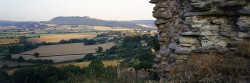
Wigmore Castle

Description

Wigmore Castle Once the stronghold of the turbulent Mortimer family, Wigmore Castle was later dismantled to prevent its use during the Civil War. Now it is among the most remarkable ruins in England, largely buried up to first floor level by earth and fallen masonry. Yet many of its fortifications survive to full height, including parts of the keep on its towering mound.

Wigmore was one of many castles built close to the England–Wales border after the Norman Conquest. Founded in 1067 by William Fitz Osbern, it was a major centre of power for over 500 years, and played host to several kings and queens. It was held by the Mortimer family from about 1075 to 1425, when it passed to the Crown. The castle fell into ruin after the Civil War and remained an untouched ruin until the 1990s, when English Heritage conserved it in a way that ensured the castle’s natural environment was preserved. 

Free Entry. If you are looking for Best place for day out with kids and families then this is the perfect destination offering fun, adventure, and unforgettable memories for everyone.

Features

  • Free
  • Host birthday parties: No

Features

  • History of Wigmore Castle: Wigmore was one of many castles built close to the England–Wales border after the Norman Conquest. Founded in 1067 by William Fitz Osbern, it was a major centre of power for over 500 years, and played host to several kings and queens. It was held by the Mortimer family from about 1075 to 1425, when it passed to the Crown. The castle fell into ruin after the Civil War and remained an untouched ruin until the 1990s, when English Heritage conserved it in a way that ensured the castle’s natural environment was preserved.
  • The First Castle: The castle was founded in 1067 by William fitz Osbern, Earl of Hereford and a close associate of William the Conqueror. It was sited close to the border between England and Wales, one of a series of castles designed by the Normans to defend England against attack by the Welsh. The original Norman castle at Wigmore had reinforced timber walls on top of large earthworks.
  • The Mortimers’ Castle: After fitz Osbern’s death in 1071 the castle passed to the Mortimer family, who held it until the early 15th century. They rebuilt the castle in stone in the 12th and early 13th centuries. The inner part of the gatehouse and the D-shaped east tower are the main survivals from this period.
  • The Earls of March: Roger Mortimer is perhaps the family’s best-known figure. He became virtual ruler of England after he and his lover, Isabella, Edward II’s estranged queen, had engineered the king’s deposition and murder in 1327.
  • Wigmore in the Civil War: During the Civil War the Parliamentarian Harleys were unable to defend both Wigmore and their main home at Brampton Bryan, so they appear to have demolished parts of Wigmore to prevent its use as a base by the Royalists.
  • A Glorious Ruin: Wigmore now has an overgrown appearance that once characterised many ruined sites. When conserving the site in the 1990s, English Heritage deliberately retained its wildness, as the castle had become home to rare and unusual species including lesser horseshoe bats and wildflowers such as ploughman’s spikenard. Accumulated debris was allowed to remain, and the grasses, ferns and flowers growing on the walls were carefully lifted up and replaced as ‘soft-capping’ to protect the walls from rain and more destructive plants like trees.

Facilities

  • Parking: Limited free parking (car park postcode HR6 9UW) is available a 15 minute walk away from the castle at the village hall (not suitable for coaches). The walk then takes you through the village and up a steep incline to the Castle.
  • Food & Drinks: There are two pubs in Wigmore village which serve food. 
  • Toilets: Toilets are available year round at the village hall and there is a disabled toilet with ramp access from the village hall car park.

Price

Price: Free

Birthday Parties

Offer Birthday Parties: No

Open any reasonable time during daylight hours.

Address: Castle St, Wigmore, Leominster, Herefordshire HR6 9UB, UK

Post Code: HR6 9UB

Council: Herefordshire

County: Herefordshire

  • Road Access: Located 8 miles West of Ludlow on A4110. Accessible via footpath 3⁄4 mile from the village on Mortimer Way.
  • Bus Access: Lugg Valley 489 (Tue, Fri only), 491 (1st, 3rd & 5th Wed only), 498 (2nd & 4th Wed only), 802 (Sun only); Roy Brown Coaches X11 (Mon only)
  • Train Access: Bucknell 6 miles, Ludlow 10 miles.
  • Bicycle Access: Find this site on The National Cycle.
  • Parking: Limited free parking (car park postcode HR6 9UW) is available a 15 minute walk away from the castle at the village hall (not suitable for coaches). The walk then takes you through the village and up a steep incline to the Castle.

0.00

0 Reviews

Rating breakdown

5
80% Complete (danger)
0
4
80% Complete (danger)
0
3
80% Complete (danger)
0
2
80% Complete (danger)
0
1
80% Complete (danger)
0

Get the best blog stories into your inbox!