Clun Castle

Clun, Craven Arms, Shropshire SY7 8JT, UK
1-99 Years
Paid

Description

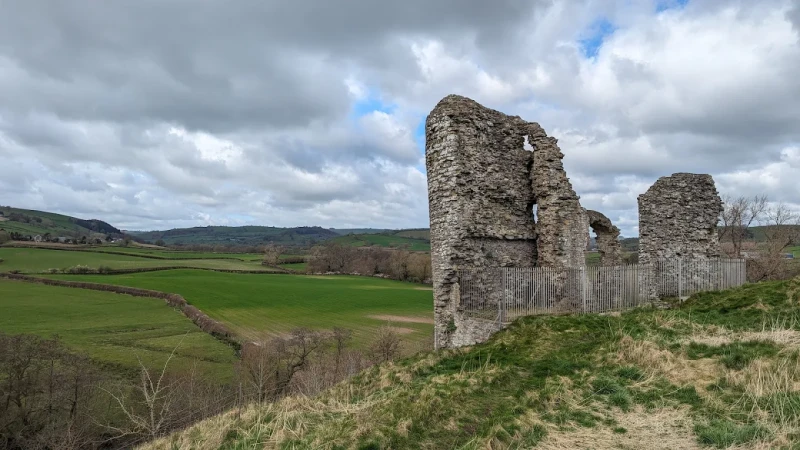
The dramatic riverside ruins and extensive earthworks of this Welsh border castle sit high on a rocky mound on the edge of the small, picturesque town of the same name. Unusually, the castle's tall 13th century keep is set on the side of its mound. Founded shortly after the Norman Conquest, the castle and nearby settlement prospered until the early 15th century, when followers of the Welsh chieftain Owain Glyn Dwr devastated the surrounding area.

Don't Miss Clun Greenman Festival held annually in May and Clun Carnival and Show held annually in August. Clun Castle sits high on a natural rocky mound in a loop of the river Clun, on the edge of the small, picturesque town of the same name. Founded shortly after the Norman Conquest to demonstrate the authority of the English monarchy over this part of the border region, the castle and the nearby settlement prospered in the 13th century thanks to the management of the Fitzalan family, but suffered a number of attacks from across the Welsh border. 

Free Entry. If you are looking for Best place for day out with kids and families then this is the perfect destination offering fun, adventure, and unforgettable memories for everyone.

Features

  • Paid
  • Host birthday parties: No

Features

  • Clun Castle sits high on a natural rocky mound in a loop of the river Clun, on the edge of the small, picturesque town of the same name. Founded shortly after the Norman Conquest to demonstrate the authority of the English monarchy over this part of the border region, the castle and the nearby settlement prospered in the 13th century thanks to the management of the Fitzalan family, but suffered a number of attacks from across the Welsh border. It was used as a hunting lodge in the 14th century, but was increasingly neglected, and by 1539 the castle was reported as ruinous.
  • Origins of Clun Castle: The original motte-and-bailey castle here was built in the late 11th century. William the Conqueror (reigned 1066–87) granted lands to some of his followers to defend the Anglo-Welsh border, which remained unsettled for many years after the Conquest. These men became powerful marcher lords, ruling their lands independently of royal control.
  • It was probably Picot de Say, who had been granted the estates of Clun and Stokesay, who built Clun Castle, high on a natural spur guarding the Clun valley. The castle became the centre of a vast lordship known as the barony of Clun.
  • The Fitzalans at Clun: In 1155 the castle passed to William Fitzalan of Oswestry by his marriage to Isabella de Say, and it was owned by the powerful Fitzalan family for the next 400 years. They exercised almost unlimited authority over the barony, administering a mixture of Welsh and English law.
  • Before the castle was built there was a small Saxon settlement at Clun, but in the 12th century a new town was laid out next to the castle with a grid of streets, containing regular ‘burgage plots’ or smallholdings.
  • Under the Fitzalans, the castle suffered a number of attacks. In 1196 Rhys, prince of south Wales, captured the castle and burned it down. In 1215 John Fitzalan joined the rebellion against King John (r.1199–1216), who sent troops to attack the castle in retaliation. The castle withstood a later siege by Llewellyn of Wales in 1233.

Facilities

  • Parking: There is a free car park next to the castle. It is not suitable for coaches.
  • Food & Drinks: Food, shops and pubs are all available in the village, which is a short walk away.
  • Toilets: Toilets are available in the car park. 

Birthday Parties

Offer Birthday Parties: No

Open any reasonable time during daylight hours.

Address: Clun, Craven Arms, Shropshire SY7 8JT, UK

Post Code: SY7 8JT

Council: Shropshire

County: Shropshire

  • Road Access: In Clun, off A488, 18 miles west of Ludlow.
  • Bus Access: Minsterley 745 (Mon & Fri only); M&J service 773 & 860 (Tue only)
  • Train Access: Hopton Heath 6 1⁄2 miles; Knighton 6 1⁄2 miles.
  • Bicycle Access: Find this site on The National Cycle Network.
  • Parking: There is a free car park next to the castle. It is not suitable for coaches.

0.00

0 Reviews

Rating breakdown

5
80% Complete (danger)
0
4
80% Complete (danger)
0
3
80% Complete (danger)
0
2
80% Complete (danger)
0
1
80% Complete (danger)
0

Get the best blog stories into your inbox!