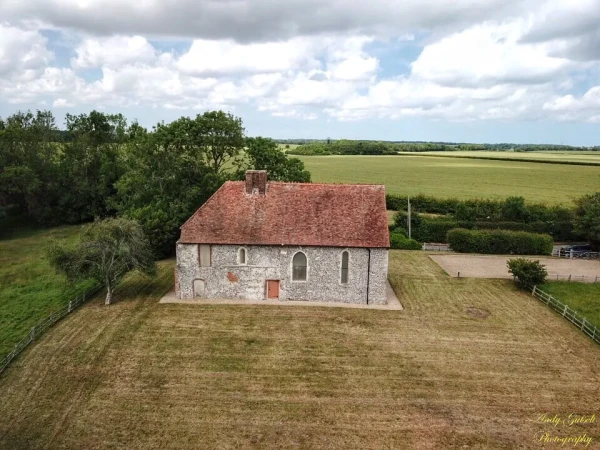
St John's Commandery

Description

St John's Commandery the flint-walled 13th-century chapel and hall of a ‘Commandery’ of Knights Hospitallers, later converted into a farmhouse. It has a remarkable medieval crown-post roof and 16th-century ceilings with moulded beams. 

All that survives today of St John’s Commandery is its 13th-century chapel. The west end of the building was partly converted for domestic use in the 16th century, and later formed part of a farmhouse.

Free Entry. If you are looking for Best place for day out with kids and families then this is the perfect destination offering fun, adventure, and unforgettable memories for everyone.

Features

  • Free
  • Host birthday parties: No

Features

  • History of St John’s Commandery: St John’s Commandery was the centre of a medieval estate run by members of the military-monastic Order of St John of Jerusalem, also known as the Knights Hospitaller. The order included both a fighting force and non-fighting men and women who cared for the sick. It had many estates like this one across Europe, each governed by a commander. The Hospitallers lost everything in England when all commanderies were closed during the Dissolution of the Monasteries in the 1530s.
  • All that survives today of St John’s Commandery is its 13th-century chapel. The west end of the building was partly converted for domestic use in the 16th century, and later formed part of a farmhouse.
  • The Knights Hospitaller: The Knights Hospitaller were founded after the First Crusade (1096–9) and the crusaders’ capture of Jerusalem in 1099. A group of crusaders formed a religious order to support a hospital in the city, dedicated to St John the Baptist, which had been founded earlier to care for Christian pilgrims. With endowments from its new governors, the hospital developed rapidly. More of a hospice than a medical establishment, it cared for people and made them comfortable.
  • The commanderies: The order acquired property across Europe by gift and endowment, the profits going to support their work in the Holy Land and eastern Mediterranean. Communities of brethren and sisters administered the Hospitaller estates, which functioned like medieval lordly agricultural estates, or manors.
  • St John’s Commandery: The community of St John’s Commandery, also known as Swingfield Preceptory, was originally established for sisters of the order, who were devoted to prayer and nursing the sick. However, in 1180 all the English sisters were assembled into one community, at Buckland in Somerset. Swingfield then became a male establishment, though a few women may have been in residence thereafter, as this was permitted by the order.
  • The Dissolution and after: In 1540, during the Dissolution of the Monasteries, Swingfield was suppressed and surrendered to the Crown. The commandery and its estate initially came into the hands of the entrepreneurial Anthony Aucher, a protégé of Thomas Cromwell. Aucher served Henry VIII in many capacities, including as a Commissioner for the Dissolution in Kent, as auditor and surveyor of the estates of Christ Church Priory, Canterbury, and as paymaster and surveyor of the royal works at Dover.
  • The chapel today: The chapel at Swingfield is the only surviving building of the commandery. It was built mainly of local flint and Kentish ragstone. Although substantially structurally complete, its modern appearance betrays its post-Dissolution use as a farmhouse and its subsequent restoration in the 1970s.

Facilities

  • Parking: Please park in the car park.
  • Dogs: Assistance dogs only.

Price

Price: Free

Birthday Parties

Offer Birthday Parties: No

St John's Commandery is open for visits by appointment - please phone 07590753394 to arrange your visit. 

Address: Swingfield, Dover, Kent CT15 7HG, UK

Post Code: CT15 7HG

Council: Folkestone and Hythe

County: Kent

  • Road Access: 2 miles north-east of Densole, off A260.
  • Bus Access: Stagecoach in East Kent 16/A Folkestone Central railway station – Canterbury, to within 1 mile.
  • Train Access: Kearsney 4 miles.
  • Bicycle Access: Find this site on The National Cycle Network.
  • Parking: Please park in the car park.

0.00

0 Reviews

Rating breakdown

5
80% Complete (danger)
0
4
80% Complete (danger)
0
3
80% Complete (danger)
0
2
80% Complete (danger)
0
1
80% Complete (danger)
0

More Day Outs in Folkestone and Hythe

Get the best blog stories into your inbox!