Hardknott Roman Fort

Hardknott Pass, Broughton-in-Furness, UK
1-99 Years
Paid

Description

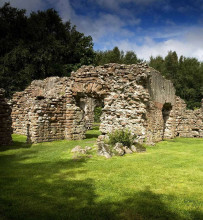
Hardknott Roman Fort This remote and dramatically sited fort was founded under Hadrian’s rule in the 2nd century. Well-marked remains include the headquarters building, commandant’s house and bath house. The site of the parade ground survives beside the fort, and the road which Hardknott guarded can be traced for some distance as an earthwork. 

Dramatically sited on a spur above the Hardknott Pass, Hardknott Fort presides over the Esk Valley, offering spectacular views of Scafell Pike and as far as the Isle of Man. It was built early in the reign of Emperor Hadrian (117–38), and helped the Roman army control the region, guarding an important road that connected the Cumbrian coast with the heart of the Lake District.

Free Entry. If you are looking for Best place for day out with kids and families then this is the perfect destination offering fun, adventure, and unforgettable memories for everyone.

Features

  • Paid
  • Host birthday parties: No

Features

  • History of Hardknott Roman Fort: Dramatically sited on a spur above the Hardknott Pass, Hardknott Fort presides over the Esk Valley, offering spectacular views of Scafell Pike and as far as the Isle of Man. It was built early in the reign of Emperor Hadrian (117–38), and helped the Roman army control the region, guarding an important road that connected the Cumbrian coast with the heart of the Lake District.
  • For centuries, its beautiful location and well-preserved remains have inspired wonder at the history of Roman Britain. Yet pottery discovered at the fort shows that it was in use for barely 20 years, and was probably abandoned by the end of Hadrian’s reign.
  • The Romans in the Lake District: Hardknott was one of three forts joined by a road that secured Roman control of the Lake District. The Roman army had rapidly established control over the south and east of Britain after the invasion of AD 43, and from around AD 70 they advanced into northern England. However, at this stage they bypassed the Lake District, instead marching north from Chester into Scotland.
  • The Hardknott garrison: The only known garrison stationed at the fort was the Fourth Cohort of Dalmatians, who were originally recruited from what is now Croatia. Although little is known about the garrison, the size of the fort suggests that they were 500 strong. They would have monitored travel along the road, enforced Roman law and responded to any trouble from the local population.
  • The fort walls and enclosure: Most Roman forts are shaped like a playing card, but Hardknott is more of a square, presumably because of the difficult and uneven terrain. The exterior walls are the best-preserved fort walls in Britain, standing to a height of 2 metres. They were partially rebuilt in the 1950s, with a slate course marking their original height below the modern reconstruction. Unlike at many Roman forts, the stonework is rough, reflecting the hardness of the rock, which was difficult for the soldiers to shape.
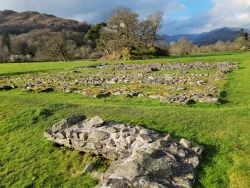
  • The central buildings: In the centre of the fort are the well-preserved remains of the fort’s three most important buildings – the granaries, headquarters building and commandant’s house.
  • The parade ground: About 200 metres east of the fort, along a track that marks the route of a small Roman road, lies a military parade ground. This is one of the rarest military features to survive from Roman Britain. To create the parade ground, the garrison moved an estimated 5,000 cubic metres of stone and earth to flatten a 140 by 80 metre area. This massive investment of effort enabled the unit to practise fighting techniques to ensure they were adequately prepared for war.
  • The bath house: Just south of the fort lie the remains of its bath house. Its three main rooms were arranged in a row. Bathers proceeded from an unheated room to a warm room before finally entering a hot room, where there was probably a hot bath. They then returned to the unheated room to finish the bathing process by taking a plunge into the cold bath.

Facilities

Parking: There is space for parking available near the fort, just off the Hardknott Pass. Take care - the road is very steep.

Birthday Parties

Offer Birthday Parties: No

Open any reasonable time during daylight hours.

Address: Hardknott Pass, Broughton-in-Furness, UK

Post Code: CA19 1TH

Council: Cumberland

County: Cumbria

  • Road Access: 9 miles north-east of Ravenglass; at west end of Hardknott Pass, via short uphill path from unclassified road.This site is not accessible to coaches. The road is a mountain pass and the road is both narrow and steep. 
  • Bus Access: Closest by bus is Stagecoach service 6 (Mon-Sat) or Stagecoach/ 3D service X6 (Sun only) to Ravenglass or Muncaster Mill then R&ER Dalegarth and then 3 1⁄2 mile walk.
  • Train Access: Dalegarth (Ravenglass & Eskdale) 3 miles or Ravenglass 10 miles.
  • Bicycle Access: Find this site on The National Cycle Network.
  • Parking: There is space for parking available near the fort, just off the Hardknott Pass. Take care - the road is very steep.

0

0 Reviews

Rating breakdown

5
80% Complete (danger)
0
4
80% Complete (danger)
0
3
80% Complete (danger)
0
2
80% Complete (danger)
0
1
80% Complete (danger)
0

Get the best blog stories into your inbox!