Description
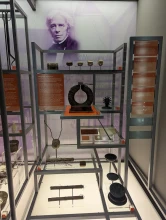
Welcome to the Faraday Museum, Explore over 200 years of history-making science in the Faraday Museum at the Ri. From the first electrical transformer to the tube that told us why the sky is blue, view the actual objects scientists of the Royal Institution built in some of the world's most famous experiments.
Discover the key role that the Ri has played in the development of the modern world – from the thermos flask to the device that saved the lives of countless miners. Visit Faraday's magnetic laboratory displayed as it was in the 1850s, opposite a current state-of-the-art nanotechnology lab.
Entry is free. If you are looking for Best place for day out with kids and families then this is the perfect destination offering fun, adventure, and unforgettable memories for everyone.
Features
- Paid
- Host birthday parties: No
Features
- Ground floor: Meet the many characters in the story of the Ri.There's our Museum's namesake, Michael Faraday, the bookbinder's apprentice who got a job here through a lucky break and went on to become a scientific hero. But there's also his boss, the arrogant yet charismatic Humphry Davy, and Ada Lovelace, mathematician and daughter of Lord Byron.You can also find out about the 14 Nobel Prize winners who have worked at the Ri.This floor includes a stunning display of some of the people that have made the Ri what it is.
- First floor: From the beginning of our history, the Ri has been famous as a place to discover and discuss the world around us. Many of the greatest scientists from the last 200 years have appeared in our famous theatre.We celebrate just a handful of them here on the first floor – in paintings, unusual props and film clips. Find out what a boomerang, a stuffed kangaroo and a saw have in common, and discover the unfortunate side effects of too much laughing gas.
- The collections: The collections of the Royal Institution include the apparatus and experimental equipment of many of the scientists, who have researched, lectured and lived in the building, alongside an impressive array of art and sculpture.
- Image collections: The Royal Institution holds an impressive collection of paintings, photographs and sculptures.Most of the major work is on display in the public areas of the building, including a set of four portraits by Henry William Pickersgill in the Grand Staircase, and paintings of lectures which hang in the Anteroom.
Object collections: The object collections of the Royal Institution include the experimental equipment of scientists who have researched, lectured and lived in the building.Incredible discoveries have occurred in the basement of 21 Albemarle Street, and a significant proportion of the objects used can still be viewed, including:
- Humphry Davy’s discovery of nine chemical elements and his invention of the Davy lamp to enable safe mining.
- Thomas Young’s establishment of the wave theory of light.
- Michael Faraday’s development of the electric motor, the electric generator, the field theory of electro-magnetism and liquefaction of gas for cooling purposes
- John Tyndall’s discovery of the greenhouse effect (radiant heat experiments)
- Lord Rayleigh’s discovery of argon.
- James Dewar’s liquefaction of hydrogen and his invention of the Dewar Flask (now more commonly known as the thermos flask)
- William Henry and William Lawrence Bragg’s invention of the X-ray analysis of crystals and biological molecules (X-ray Crystallography)
- George Porter’s discovery of laser analysis of very fast chemical reactions.





 0.20 miles