Carlisle Cathedral

Description

Carlisle Cathedral is a historic cathedral in the heart of the border city of Carlisle, offering a peaceful and inspiring space for worship, reflection, and exploration. Founded as a Norman Priory in 1122 and becoming a cathedral in 1133, it has served as the mother church of the Diocese for over 900 years. Today, it welcomes visitors of all backgrounds as a place of faith, history, and quiet rest.

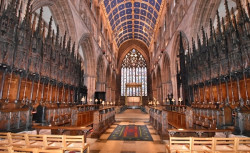
Visitors can explore outstanding features including the famous Choir Ceiling, Bishops’ Throne, and the magnificent East Window, the largest flowing decorated Gothic window in England. Other highlights include medieval choir stalls and misericords, the Brougham Triptych, Gondibour and Salkeld Screens, painted panels, regimental chapel, runic inscriptions, the Treasury exhibition, and historic memorial windows. The Cathedral also offers an award-winning cathedral café, regular exhibitions, and access to centuries of architecture and craftsmanship.

Entry to Carlisle Cathedral is free, with a suggested donation of £5 per adult visitor to support its upkeep. The Cathedral also offers venue hire for events, meetings, concerts, and celebrations, with spaces including the Fratry Hall, Fratry Undercroft, Prior’s Room, Cathedral Café, and the Cathedral itself. 

Overall, Carlisle Cathedral offers a calm and enriching visitor experience rooted in history and community. It combines remarkable architecture, rare artefacts, and a welcoming atmosphere in one setting. This attraction is ideal for history lovers, cultural visitors, those seeking quiet reflection, and anyone exploring Carlisle’s heritage.

Features

  • Free
  • Host birthday parties: Yes

Features

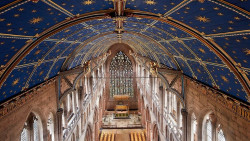
  • Choir Ceiling: While the Cathedral was first built in the 12th century, the ceiling’s main timbers date from 1400 – put in place following a devastating fire in 1292. The decorative scheme dates from Ewan Christian’s restoration of the Cathedral 1853-6. The style follows the medieval original, but the detailed design and colour (angels and stars) was the work of Owen Jones, one of the great decorative artists of the day. The story of our iconic ceiling is available in the excellent book Heaven’s Above, by Jim Palmer, available from the cathedral’s Welcome Centre.
  • Bishops' Throne: The throne or seat – ‘cathedra’ – of the Bishop in any Cathedral is the feature that gives the building its name. The present throne is on the south side of the choir adjacent to the stalls. It is in the same style as the stalls and was designed by the architect G E Street. The throne is decorated with the coat of arms of Bishop Harvey Goodwin (1869–91).
  • East Window: The East Window dates from c.1350, and was put in as part of the rebuilding of the Cathedral after the 1292 fire. It is over 50 feet high and has been attributed to Ivo de Raghton. Some of the original stained glass towards the top – depicting the last judgement of Christ – survives in the very fine tracery. 
  • Brougham Triptych: The Brougham Triptych was made in Antwerp in about 1520, and bears the trademark of the Antwerp Guild of Woodcarvers. It may have been in a church in Cologne before it was bought in the 1840s by Baron Brougham & Vaux to decorate St Wilfred’s Chapel, Brougham. Although it lacks two doors to make triptych wings, it is a fine example of its type. The altarpiece portrays Christ’s passion and includes infancy and resurrection themes.
  • Gondibour Screens: The Gondibour screens – both in curvilinear style – sit on either side of the Welcome Centre. They take their name from Thomas Gondibour, Prior of St Mary’s Cathedral Priory between 1465 and 1500. Gondibour’s initials are incorporated into the carving on the door. The two screens have been heavily restored, which probably occurred in the 18th century when they were moved from their original positions between the pillars of the choir.
  • Misericords: Each of our 46 choir stalls incorporates a misericord, a tip-up seat which enables a Canon at worship to stand, sit or perch in a position good for singing. Typically misericords incorporate ornate carvings on their underside, with designs which are usually not religious, except for an occasional angel. The designs often incorporate mythical beasts, birds or animals. These misericords and choir stalls date from 1400-1419. In the course of repair, they were found to have a thin wash of gold paint.
  • Painted Panels: On the back of the choir stalls are four sets of painted panels. One depicts the 12 apostles, each with a section of the Creed. The other three illustrate the lives of St Anthony of Egypt, the founder of monasticism, St Augustine of Hippo, considered to be the founder of the Augustinian Canons, and St Cuthbert of Lindisfarne, who visited Carlisle in the years 685 and 686. The texts of the lives of these saints are written in Anglo-Saxon. 
  • Regimental Chapel: Although the Regimental Chapel was only formally established in 1949, that area of the west end of the Cathedral has had an assembly of war memorial and personal military memorials, dating back to 1856; and regimental colours dating back to 1745. They reflect the transition of the local regiment from the 34th Regiment of Foot to the Border Regiment, the King’s Own Regiment; and the present Duke of Lancaster’s Regiment. 
  • Runic Inscriptions: Of just 17 Scandinavian runic inscriptions in mainland England, two – both dating from the 12th century – have been found in the Cathedral. One was discovered in 1855 just inside the main door, when paint and plaster were being removed from the walls. It is now behind glass and reads: ‘Dolfin wrote these runes on this stone.’ The second, found in 2008 in the south transept triforium (first floor) level, is the single name ‘Reginald’, carved into a stone that was moved from its original position in the early 13th century to block a disused doorway.
  • Salkeld Screen: The Salkeld Screen is so-called because it bears the initials of Lancelot Salkeld, Dean of Carlisle, who became Dean in 1541, and the arms of Henry VIII, who died in 1547. The screen stands out in style as distinctly renaissance in a predominantly Romanesque and Gothic building. The design incorporates very fine carvings of 12 heads, six on each side. Most of the characters bear some relation to Henry VIII. Some are in contemporary dress, others in Roman style.
  • Tait Memorial Window: The Tait Memorial Window in the north transept commemorates the five daughters of Dean Archibald Campbell Tait and his wife Catherine. Aged between 10 years and 18 months, they died in a 33 day period from 6 March to 8 April 1856. Even in those days of high infant mortality, their deaths caused a sensation. The children were all buried in Stanwix graveyard, where there is a memorial to them. 
  • The Treasury: The excavation of this area in 1988 was an important archaeological dig, and exposed several Viking graves. The Treasury Exhibition was opened by the Duke of Gloucester with the aim of safeguarding and displaying the ‘treasures’ of the parishes of the diocese and of the Cathedral. It also contains a series of illustrated panels which tell the story of the history of Christianity in Cumbria from the beginning to the present day. 

Facilities

  • Parking: Parking available nearby. 
  • Food & Drinks: Our award-winning café sits at the heart of the Cathedral precinct in the footprint of the medieval cloister, with unrivalled views of the Cathedral and Precinct. Open daily for hearty homemade food, cakes, coffee and more. 
  • Toilets: Toilet available. 

Price

Price: Free

Birthday Parties

Offer Birthday Parties: Yes

Birthday Party Details

Venue Hire

  • Fratry Hall: Carlisle’s 14th century Fratry Hall is a jewel at the heart of the Cathedral precinct and one of the most unique spaces in the city. Over the past 600 years the Fratry has been used as the abbey’s dining hall, a grain store, a prison, a Civil War armoury and a brewery… it now houses the magnificent library collected by Bishop Thomas Smith (1615-1702). With a splendid wooden vaulted ceiling and stone fireplace, the Fratry Hall is the perfect space to make an impression. The Hall is used for concerts, talks and exhibitions throughout the year, but is flexible enough to work for any event – from dinners and afternoon teas, to ceremonies and product launches.
  • Fratry Undercroft: Beneath the Fratry Hall you’ll find one of Carlisle’s hidden gems – the Undercroft. With a magnificent stone-ribbed ceiling, this medieval space has been fully-refurbished with a 21st century flair. Ideal for a more intimate event, the atmospheric Undercroft is flexible enough to work for any gathering, concert or exhibition in its own right, or as an additional break-out space for an event in the Fratry Hall itself.
  • Prior's Room: If you’re looking for a meeting space with a unique atmosphere, the early 16th century Prior’s Room is the perfect solution. With its rare painted ceiling, stone fireplace and impressive views of the Cathedral, the Prior’s Room makes the most mundane meeting a memorable one. Set out in a hollow boardroom style, the room is private, with its own access away from the rest of the Cathedral’s buildings. The ground floor of the Prior’s Tower can be used as an additional breakout space or waiting area.
  • Cathedral Café: The newest addition to the historic Cathedral precinct, our pavilion café has been beautifully designed by award-winning architects Feilden Fowles, and sits in the footprint of the original medieval cloister. With high windows offering views of the Cathedral and with access to the outdoor seating area, the pavilion is the perfect place for a statement event or private function.
  • The Cathedral: Was there ever a more magnificent backdrop than our majestic East Window and iconic starlight ceiling? From concerts to award ceremonies, special services and celebrations… create unforgettable memories with an event in Carlisle Cathedral.
  • Mon-Fri: 7.30am to 6:30pm
  • Sat-Sun: 7.30am to 5.00pm

Address: The Abbey, Carlisle, Cumbria, CA3 8TZ, England

Post Code: CA3 8TZ

Council: Cumberland

County: Cumbria

  • By Car: The Cathedral is on Castle Street. There are pay and display car parks nearby: at English Damside, Viaduct and Devonshire Walk. 
  • By Bus: The Cathedral is a five minute walk from the central bus station. 
  • By Train: Carlisle is on the West Coast Mainline, the Settle-Carlisle line and the Newcastle-Carlisle line.  The Cathedral is a ten minute walk from the station.

5

0 Reviews

Rating breakdown

5
80% Complete (danger)
0
4
80% Complete (danger)
0
3
80% Complete (danger)
0
2
80% Complete (danger)
0
1
80% Complete (danger)
0

Get the best blog stories into your inbox!