
Skipsea Castle

B1249, Beeford, Driffield, East Yorkshire YO25 8TH, UK
1-99 Years

Description

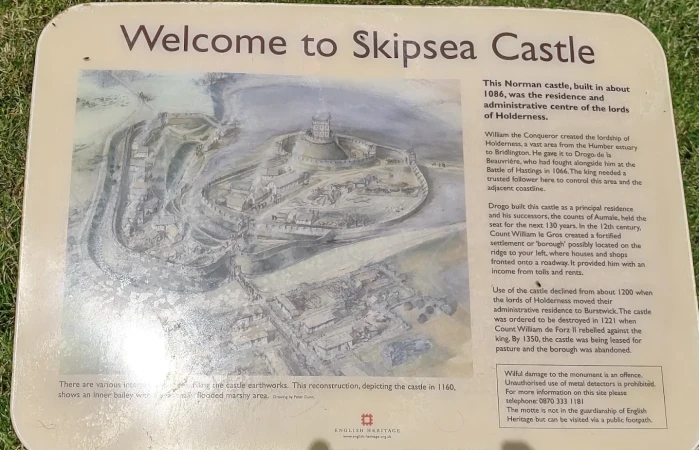
Skipsea Castle an impressive Norman motte and bailey castle, dating from before 1086 and among the first raised in Yorkshire, with the earthworks of an attendant fortified 'borough'. The Norman castle at Skipsea, built in about 1086, was the residence and administrative centre of the lords of Holderness.  

William the Conqueror created the lordship of Holderness, a vast area from the Humber estuary to Bridlington. He gave it to Drogo de la Beauvrière, who had fought alongside him at the Battle of Hastings in 1066. The king needed a trusted follower there to control the area and the adjacent coastline.

Free Entry. If you are looking for Best place for day out with kids and families then this is the perfect destination offering fun, adventure, and unforgettable memories for everyone.

Features

  • Free
  • Host birthday parties: No

Features

  • History of Skipsea Castle: The Norman castle at Skipsea, built in about 1086, was the residence and administrative centre of the lords of Holderness. William the Conqueror created the lordship of Holderness, a vast area from the Humber estuary to Bridlington. He gave it to Drogo de la Beauvrière, who had fought alongside him at the Battle of Hastings in 1066. The king needed a trusted follower there to control the area and the adjacent coastline.
  • Recent research has revealed that the mound at Skipsea, previosuly thought to be a motte created by the Normans, dates from the Iron Age.
  • The earlier stages of the mound are now known to be of Iron Age date – probably a burial mound. This was later adapted as a medieval motte.
  • Drogo de la Beauvrière built Skipsea Castle as a principal residence and his successors, the Counts of Aumale, held the seat for the next 130 years. The castle would probably originally have been built from timber, and later rebuilt in stone.
  • The motte and bailey would have been vulnerable to attack from the higher ground. To guard against this, in the 12th century Count William le Gros created a fortified settlement or ‘borough’, possibly located on the ridge and known as Skipsea Brough like the modern settlement. Its houses and shops fronted onto a roadway and it provided him with an income from tolls and rents. It was enclosed within a massive earth rampart which also encompassed the main through route descending to the easiest crossing of the marshy ground.
  • Today, it is difficult to understand why a castle was built in this apparently remote area. Evidently the route crossing the marsh must have been more important in the Middle Ages. The small coastal port that the lords of Holderness tried to develop nearby failed to thrive and there is little evidence to suggest that the town on the ridge proved any more successful: there are few traces of buildings. Ultimately, neither town nor castle was sufficiently well sited to encourage its continued use.
  • Use of the castle declined from about 1200 when the lords of Holderness moved their administrative residence to Burstwick. The castle was ordered to be destroyed in 1221 when Count William de Forz II rebelled against the king. By 1350 the castle was being leased for pasture and the borough was abandoned.
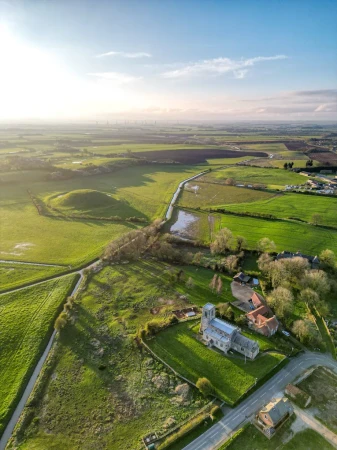
  • Landscape Setting: Motte-and-bailey castles of this type are not rare, but Skipsea’s conical mound is exceptionally large – 278 feet (85 metres) in diameter and 42 feet (13 metres) high. It has long been assumed to be of Norman origin, but has recently been identified as an Iron Age earthwork. Analysis of datable material extracted by drilling a borehole through the mound has revealed it to be 2,500 years old, and therefore the largest Iron Age mound in Britain.
  • Description: Visitors approach through the gate and walk up to the brow of the ridge. The motte, surrounded by a low rampart, can be seen ahead to the north. The bailey was in front of this but parts of its defences are now difficult to distinguish as a result of later ploughing. The defensive bank that surrounded the borough, to the left, remains more obvious. The mere lay behind the motte and would have extended into the natural channel along the foot of the ridge, separating the borough from the bailey.

Facilities

  • Parking: There is no formal parking at the castle. Please park considerately on the road.
  • Food & Drinks: Nearby Skipsea has a pub, post office and service station.
  • Dogs: Dogs on leads are welcome.

Price

Price: Free

Birthday Parties

Offer Birthday Parties: No

Open any reasonable time during daylight hours.

Address: B1249, Beeford, Driffield, East Yorkshire YO25 8TH, UK

Post Code: YO25 8TH

Council: East Wolds and Coast

County: East Riding of Yorks

  • Road Access: Located 8 miles south of Bridlington; west of Skipsea village.
  • Bus Access: Phoenix Buses service 136 pass within 1⁄3 mile; East Yorkshire services 130 & X30 serve Skipsea village.
  • Train Access: Bridlington 9 miles.
  • Bicycle Access: Find this site on The National Cycle Network.
  • Parking: There is no formal parking at the castle. Please park considerately on the road.

0.00

0 Reviews

Rating breakdown

5
80% Complete (danger)
0
4
80% Complete (danger)
0
3
80% Complete (danger)
0
2
80% Complete (danger)
0
1
80% Complete (danger)
0

More Day Outs in East Riding of Yorkshire

Get the best blog stories into your inbox!